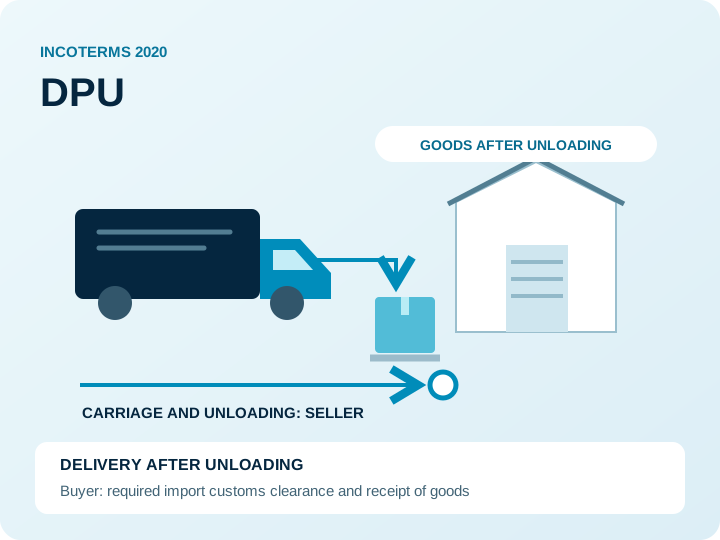
DPU means delivering and unloading the goods at the named destination. The seller is responsible for carriage and unloading; the buyer handles required import customs clearance. Agree the exact delivery point and check that safe unloading is possible.
DPU AT A GLANCE
The seller brings and unloads the goods. The buyer arranges the required import formalities. DPU is the only Incoterms 2020 rule requiring the seller to unload at destination.
What does DPU Incoterms 2020 mean?
DPU stands for “Delivered at Place Unloaded”. The seller arranges delivery to the named destination and unloading, then makes the goods available to the buyer.
The rule suits any mode of transport, including multimodal journeys. In Incoterms 2020, DPU replaced the previous DAT name, highlighting that delivery after unloading can take place somewhere other than a terminal.
DPU — delivery and risk during unloading
Risk normally transfers when the goods have been unloaded from the arriving means of transport and placed at the buyer’s disposal at the named destination or agreed point within it.
The seller bears the risk of bringing and unloading the goods up to that point. A vehicle merely arriving at the warehouse therefore does not complete DPU delivery.
| Area | Who is responsible? |
|---|---|
| Carriage to destination | The seller arranges and pays for carriage. |
| Unloading at the delivery place | The seller — after confirming that unloading can be performed. |
| Export and transit | The seller performs required export and transit formalities in countries other than the import country. |
| Import and duties | The buyer arranges and pays for required import customs clearance. |
| Insurance | DPU creates no mutual obligation to contract insurance. |
Check unloading feasibility before shipment
Agree available equipment, ground requirements, access to the delivery place, vehicle type and working hours. The seller should confirm that unloading can be arranged at the agreed point. If the buyer is to take on unloading and its risk, compare DAP.
How should the DPU delivery place be specified?
Specify the address and exact point where the unloaded goods will be made available to the buyer. This determines delivery completion, standard risk transfer and cost allocation.
FICTIONAL WORDING EXAMPLE
DPU buyer’s warehouse, 10 Example Road, Manchester, receiving zone B, Incoterms® 2020
Agree the unloading method, equipment, permitted vehicle and timing. The place should be accessible and prepared for the particular goods.
An imprecise point may lead to disputes not only about additional carriage but also where unloading is completed. “DPU Manchester” may therefore need more detail.
DPU — export and import customs clearance
The seller arranges and pays for required export customs formalities and transit formalities in countries other than the import country. The buyer performs and pays for required import customs clearance, obtains necessary documents and bears allocated duties and charges.
The parties assist each other in obtaining documents and information under A7/B7. The seller’s unloading obligation does not also transfer import responsibilities to the seller.
DPU, DAP or DDP — what does unloading change?
| Area | DPU | DAP | DDP |
|---|---|---|---|
| Delivery | After unloading | Before unloading | Before unloading, with required import formalities completed |
| Unloading | Seller | Buyer | Buyer |
| Import customs clearance | Buyer | Buyer | Seller |
| Carriage to destination | Seller | Seller | Seller |
Read the DAP terms — delivery before unloading →
Read the DDP terms — seller’s import formalities →
DETAILED DIVISION OF RESPONSIBILITIES
DPU — seller’s and buyer’s obligations
Ten areas, A1–A10 and B1–B10, let you examine both sides of the same delivery. Compare seller and buyer duties in each area, from delivery and documents to costs and notices. This is a discussion of the rule, not a sales contract or the full ICC publication.
01 General obligations
A1 · Seller
The seller provides the goods, commercial invoice and other documents required by the sales contract. Documents supplied by the seller may be paper or electronic, as agreed or customary.
B1 · Buyer
The buyer pays the price specified in the sales contract. Documents supplied by the buyer may be paper or electronic, as agreed or customary.
02 Delivery
A2 · Seller
The seller unloads the goods from the arriving means of transport, then delivers by making them available to the buyer at the agreed destination point, if agreed, or procures goods already delivered in that way. In either case, delivery must be on the agreed date or within the agreed period.
B2 · Buyer
The buyer must take delivery when the goods have been delivered under (A2).
03 Transfer of risk
A3 · Seller
The seller bears the risk of loss or damage until delivery under (A2), except in the circumstances described under the buyer’s risk-transfer obligations (B3).
B3 · Buyer
The buyer bears the risk of loss or damage from delivery under A2. Pre-delivery exceptions must be considered separately:
- failure to fulfil B7 obligations places the resulting risk on the buyer;
- failure to give the B10 notice places risk on the buyer from the agreed date or end of the agreed delivery period.
The goods must be clearly identified as the contract goods. The exception does not make the buyer automatically responsible for every event before delivery.
04 Carriage
A4 · Seller
The seller must contract or arrange carriage at the seller’s expense to the named destination or an agreed point within it. If no precise point is agreed or established by practice, the seller may choose the point at destination that best suits the seller’s purpose.
The seller must comply with all transport safety requirements up to destination.
B4 · Buyer
The buyer has no obligation to contract carriage.
05 Insurance
A5 · Seller
The seller has no obligation to contract insurance.
B5 · Buyer
The buyer has no obligation to contract insurance. However, at the seller’s express request, cost and risk, the buyer must provide the information needed to obtain insurance.
06 Delivery or transport document
A6 · Seller
The seller must provide the buyer, at the seller’s expense, with all documents needed to enable the buyer to receive the goods.
B6 · Buyer
The buyer must accept the document provided under (A6).
07 Export and import customs clearance
A7 · Seller
Where formalities are required, the seller carries out and pays for export customs clearance and transit formalities in countries other than the import country. This includes necessary licences, authorisations, safety requirements and pre-shipment inspections.
For import, the seller assists at the buyer’s request, cost and risk in obtaining import customs clearance documents and information, including safety and pre-shipment inspection matters.
B7 · Buyer
The buyer assists at the seller’s request, cost and risk in obtaining documents and information for export customs clearance and formalities in transit countries other than the import country, including safety and pre-shipment inspection requirements.
Where formalities are required, the buyer arranges and pays for import customs clearance and obtains necessary licences, authorisations and other documents, including safety and pre-shipment inspection documents.
08 Checking, packaging and marking
A8 · Seller
The seller pays for checking operations needed for delivery under (A2), such as quality checks, measuring, weighing and counting. The seller also packages the goods at the seller’s expense and marks them suitably for transport, unless the parties have agreed specific packaging or marking requirements.
Goods customarily carried unpackaged are an exception. Packaging and marking should suit the agreed transport or the parties’ specific requirements.
B8 · Buyer
The buyer has no obligations towards the seller in this respect.
09 Allocation of costs
A9 · Seller
The seller must pay:
- all costs relating to the goods until unloaded and delivered under (A2), except the buyer’s costs under (B9);
- costs of providing the delivery / transport document under (A6);
- duties, taxes and all other export and transit customs clearance costs under (A7), where applicable;
- the buyer’s costs and charges for assistance in obtaining documents and information under (B5) and (B7a).
B9 · Buyer
The buyer must pay:
- all costs relating to the goods from delivery under (A2);
- the seller’s costs and charges for assistance in obtaining documents and information under (A7b);
- duties, taxes and all other import customs clearance costs under (B7);
- any additional costs incurred by the seller if the buyer fails to fulfil (B7) obligations or give notice under (B10), provided the goods can be clearly identified as the contract goods.
10 Notices
A10 · Seller
The seller must give the buyer all notices needed to take delivery.
B10 · Buyer
Whenever it is agreed that the buyer may determine a date within the agreed period and/or a receiving point at the named destination, the buyer must give the seller sufficient advance notice.
What to watch for in practice
- Confirm unloading feasibility. Agree equipment, access, permitted vehicle and working conditions at destination.
- Do not equate unloading with import. DPU leaves required import customs clearance and duties with the buyer.
- Prepare documents before arrival. The buyer’s failure to fulfil import obligations may cause the additional costs and risk described in B3/B9.
- Specify the point after unloading. Agree where goods are made available to the buyer. The vehicle arriving alone does not complete DPU delivery.
Incoterms allocate specified obligations, costs and risk between seller and buyer. They do not replace customs law, the carriage contract or agreements on payment and transfer of ownership.
Questions about DPU terms
What does DPU mean?
Delivered at Place Unloaded means making goods available to the buyer after unloading at the named destination. The rule suits any mode of transport, including multimodal journeys.
Who unloads under DPU?
The seller arranges and pays for unloading at the agreed place. The seller should confirm feasibility in advance, including equipment availability and access conditions.
When does risk transfer under DPU?
Generally after unloading, when goods are available to the buyer at the agreed point. B3 provides exceptions, including those connected with the buyer’s failure to fulfil B7 customs obligations.
Who carries out import customs clearance?
The buyer arranges and pays for required import customs clearance. The seller handles export and transit formalities in countries other than the import country.
Does DPU have to mean delivery to a terminal?
No. DPU replaced DAT in Incoterms 2020 to highlight that delivery after unloading can take place at another agreed place too.
How does DPU differ from DAP?
Under DPU, the seller delivers after unloading. Under DAP, the goods are made available on the arriving means of transport ready for unloading, and the buyer is responsible for unloading.
Great Britain: prepare the customs arrangements
These Incoterms rules allocate contractual costs, tasks and risk between seller and buyer. For a movement to or from Great Britain (England, Scotland and Wales), also agree who will be identified in the customs declaration, the form of representation, any required EORI registration and who will fund duty and import VAT. The delivery term alone does not establish eligibility to act as importer or a right to recover VAT. Northern Ireland has separate arrangements.
Compare delivery terms
Plan your customs clearance with Simple Duty
Send the delivery term and exact named place, dispatch and destination countries, a description of the goods and the planned date. We will review the requested customs service and confirm our role. Online document handling does not remove the requirement to present goods to customs where required.