EXW Delivery Terms | Incoterms 2020
What does the EXW Delivery Terms mean?
In the previous two articles, I explained what the Incoterms® Delivery Terms are, how they should be used, and the changes introduced by the International Chamber of Commerce (ICC) in Incoterms® 2020.
Now it’s time to take a closer look at each individual Incoterms® 2020 rule.
The first rule, applicable to all modes of transport, is EXW (Ex Works) – Ex Works (named place of delivery).
Example: EXW London Incoterms® 2020
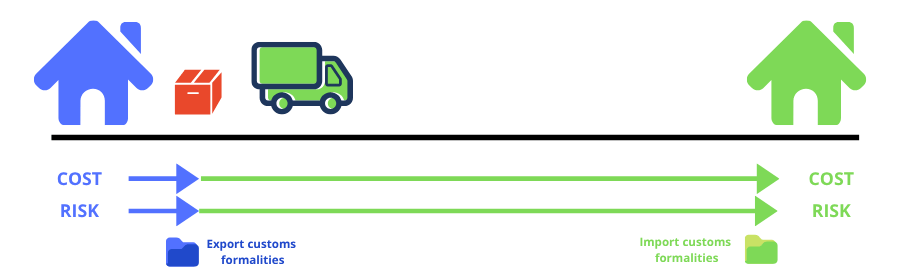
EXW Delivery Terms | Delivery and Transfer of Risk
“EXW (Ex Works) …” means that the seller delivers the goods to the buyer by placing them at the buyer’s disposal at the location specified in the contract. The seller is only required to make the goods available at the named place (for example, at a factory or warehouse). The named place may, but does not have to, be the seller’s premises.
Under the EXW rule, the seller is not responsible for loading the goods onto the collecting vehicle or for completing export customs clearance.
EXW is the Incoterms® rule that imposes the fewest obligations on the seller. The buyer assumes the majority of responsibilities, including loading the goods, bearing the risks, and covering the transport-related costs.
EXW Delivery Terms | Mode of Transport
The EXW Incoterms® 2020 rule may be used for any mode or combination of modes of transport.
EXW Delivery Terms | Place or Point of Delivery
The seller and the buyer only need to specify the named place of delivery. However, it is strongly recommended to identify the exact point within that place where the goods will be made available.
Clearly defining the delivery point helps determine precisely when delivery takes place, when the risk transfers to the buyer, and when the buyer becomes responsible for the costs. To avoid disputes or misunderstandings, the parties should agree on a specific delivery point in advance.
EXW Delivery Terms | Loading of the Goods and Transfer of Risk
The seller’s responsibility is limited to making the goods available at the agreed place of delivery. The risk transfers to the buyer as soon as the goods are placed at the buyer’s disposal, before they are loaded onto the collecting vehicle.
In practice, the buyer is often not physically present during loading. Even if the seller performs the loading, the risk of loss or damage during that operation will, in many cases, still rest with the buyer under the EXW rule.
For this reason, if the seller is expected to load the goods, both parties should clearly agree in advance on who bears the risk of loss or damage during the loading process.
In many cases, loading takes place at the seller’s premises because the seller has the necessary equipment. The buyer, or the buyer’s representative, may not even be allowed access to the premises due to safety or security requirements.
If the buyer wishes to avoid assuming the risk during loading at the seller’s premises, FCA (Free Carrier) is generally the more appropriate Incoterms® rule.
EXW Delivery Terms | Export Customs Clearance
When the EXW rule is used in international trade with non-EU countries, the seller is not responsible for arranging export customs clearance, even though export clearance is required before the goods can leave the European Union.
The seller is also under no obligation to participate in customs formalities in the destination country.
The EXW Incoterms® 2020 rule may also be used for domestic transactions, where no export of the goods is intended.
If necessary, the buyer may ask the seller to assist in obtaining documents or information required for export, although the seller has no obligation to do so under the EXW rule.
EXW Delivery Terms | Seller’s and Buyer’s Obligations
Although EXW places the fewest obligations on the seller, both the seller and the buyer still have specific responsibilities that must be fulfilled.
Below, we will explain these responsibilities in accordance with the ten-article structure of the Incoterms® 2020 rules, providing a detailed overview of the obligations of both the seller and the buyer.
1. Seller’s Obligations
A1 (General Obligations)
The seller must provide the goods, the commercial invoice, and any other documents required under the contract of sale.
A2 (Delivery)
The seller must deliver the goods by placing them at the buyer’s disposal at the agreed point (if one has been specified) within the named place of delivery, without loading them onto the collecting vehicle.
If no specific point has been agreed within the named place of delivery and several points are available, the seller may choose the point that best suits its purpose.
The seller must deliver the goods on the agreed date or within the agreed delivery period.
A3 (Transfer of Risk)
The seller bears the risk of loss of or damage to the goods until delivery has been made in accordance with A2.
An exception applies where the loss or damage occurs in circumstances described under the buyer’s obligations relating to the transfer of risk (B3).
A4 (Carriage)
The seller has no obligation to the buyer to arrange a contract of carriage.
However, at the buyer’s request, the seller must provide any information available to the seller that is necessary for the buyer to arrange carriage, including any transport-related security requirements.
A5 (Insurance)
The seller has no obligation to obtain insurance for the benefit of the buyer.
However, at the buyer’s request, the seller must provide any information available that is necessary for the buyer to obtain insurance.
A6 (Delivery / Transport Document)
The seller has no obligation to provide a transport or delivery document under this rule.
A7 (Export / Import Clearance)
At the buyer’s request, the seller must assist in obtaining any documents or information required for export or import customs formalities.
Such documents or information may include, for example:
- export or import licences,
- official authorisations,
- pre-shipment inspection certificates,
- or other documents required by the relevant authorities.
A8 (Checking / Packaging / Marking)
The seller must bear the cost of all checking operations necessary for delivering the goods in accordance with the contract, such as:
- quality inspections,
- measuring,
- weighing,
- counting.
The seller must also package and mark the goods appropriately for the intended transport, unless the parties have agreed on specific packaging or marking requirements.
A9 (Allocation of Costs)
The seller bears all costs relating to the goods until they have been delivered in accordance with A2.
The exception is any costs that are expressly allocated to the buyer under B9.
A10 (Notices)
The seller must provide the buyer with any notice necessary to enable the buyer to take delivery of the goods.
2. Buyer’s Obligations
B1 (General Obligations)
The buyer must pay the price for the goods as agreed in the contract of sale.
B2 (Taking Delivery)
The buyer must take delivery of the goods when they have been delivered in accordance with A2 and after receiving the notice provided by the seller under A10.
B3 (Transfer of Risk)
The buyer bears all risks of loss of or damage to the goods from the moment they have been delivered in accordance with A2.
If the buyer fails to notify the seller of the time for dispatch and/or the specific collection point (where applicable), the buyer bears all risks of loss of or damage to the goods from the agreed delivery date or from the end of the agreed delivery period, provided that the goods have been clearly identified as the goods covered by the contract of sale.
B4 (Carriage)
The buyer is responsible, at its own expense, for arranging or contracting the carriage of the goods from the named place of delivery.
B5 (Insurance)
The buyer has no obligation to obtain insurance for the benefit of the seller.
B6 (Proof of Delivery)
The buyer must provide the seller with appropriate evidence that the goods have been taken into delivery.
B7 (Export / Import Clearance)
The buyer is responsible for completing and paying for all customs formalities.
These may include, for example:
- obtaining export or import licences,
- securing official authorisations,
- paying customs duties, taxes and other governmental charges,
- completing all customs clearance procedures.
B8 (Checking / Packaging / Marking)
The buyer has no obligations towards the seller regarding checking, packaging or marking of the goods.
B9 (Allocation of Costs)
The buyer must:
- pay all costs relating to the goods from the moment they have been delivered by the seller in accordance with A2;
- reimburse the seller for any costs incurred in providing assistance with carriage, insurance or customs formalities;
- pay all customs duties, taxes and other charges, together with the costs of export customs formalities;
- bear any additional costs arising from failure to take delivery of the goods when required.
B10 (Notices)
Where it has been agreed that the buyer is entitled to determine the time of dispatch and/or the collection point within the named place of delivery, the buyer must notify the seller sufficiently in advance.
Need Help with EXW Shipments?
Choosing the right Incoterms® rule can have a significant impact on your costs, responsibilities and customs obligations. Although EXW (Ex Works) appears simple, it often creates practical challenges—especially when international transport, export customs clearance or customs documentation are involved.
At Simple Duty, we help importers, exporters and freight forwarders with:
- customs declarations across the UK and the EU,
- transit procedures (T1),
- export and import customs clearance,
- customs consultancy,
- customs compliance and documentation.
If you’re unsure whether EXW is the right Incoterms® rule for your shipment—or need assistance with customs formalities—our customs specialists are here to help.
📩 Contact Simple Duty and we’ll help you choose the right customs solution for your shipment.